
How local authorities can respond to devolution’s funding shift
Posted on 07 Oct 2026
While most funding programmes run by local authorities "were designed to award grants”, the new…
Posted on 25 Aug 2026
By Kathy Richardson, executive director, SmartyGrants UK

A decade of independent audit evidence reveals there’s a big gap between good grants policy and good grants practice. Here’s what that gap looks like, and what to do about it.
Most UK funders I talk to think a lot about how to improve their grants systems. Better portals. Clearer guidelines. Simpler application forms. Cleaner data. Tidier reporting.
That’s not a British thing. We see the same focus areas for grantmakers we work with across the world.
The Australian arm of SmartyGrants has just published a review of 66 audit reports on Australian government grants, covering 2015 to 2025 and every jurisdiction in the country. Australia runs public grants under a Westminster-style framework it inherited from the UK: independent auditors reporting to parliaments, central lifecycle guidance, the same annual pressure to get money out of the door before the year ends. There are differences between UK and Australian systems, but there are also a remarkable number of similarities.
Our report uncovered six problems that occurred across the decade, across jurisdictions and across programmes of every type and size. Chances are, some of them occur in your programmes too:
Grants run on a platform, on a couple of local systems and maybe on a set of spreadsheets, producing shadow records that sit outside the official system of record. Nobody has a reliable view of the whole portfolio. If a key person leaves, a chunk of knowledge leaves with them.
Programmes set out broad aspirations, then make decisions that don’t necessarily support those aspirations. Evaluation gets treated as something you do at the end, if there’s budget left, which there never is.
Auditors repeatedly found decisions that were out of step with defined merit rankings, mostly without recorded justification.
Conflict of interest declarations, probity steps and standards exist on paper but are applied inconsistently in practice, particularly in smaller teams under time pressure.
Reports from grantees arrive late, incomplete or unverified. Recovery of unspent funds happens reactively, if at all. All the focus is on getting the money out the door, not ensuring it has properly hit its target.
This is the factor that underpins all the others. Programmes get handed to capable people who have never designed an evaluation, assessed a conflict of interest or built an outcomes framework. They’re not properly trained, and they’re never given the time and resources they need to do the job properly.
The most useful finding in our review is perhaps the most pedestrian. The problem, we found, is no longer an absence of good policy. Every Australian jurisdiction now has a grants framework built on transparency, proportionality, risk management and outcomes, and most of them say sensible things.
You probably have a great set of policies too.
The problem is that there is a gap between the framework and what happens on the last day of the financial year, when the money has to be committed and nobody has properly defined what it was meant to change.
“The media release was drafted, the Minister was briefed, a few interviews were conducted, and before long, everyone moved on.”
SmartyGrants’ Australian-based Group Managing Director, Denis Moriarty, ran grants programmes as a senior public servant before founding Our Community (SmartyGrants’ parent company). Denis saw the cycle from the inside before he shifted to the outer.
“Whenever an Auditor-General's report arrived, the departmental response followed a familiar script. We welcomed the report, accepted the recommendations, acknowledged there were lessons to learn and reassured everyone that public money was always being managed to the best of our ability,” he says.
“The media release was drafted, the Minister was briefed, a few interviews were conducted, and before long, everyone moved on.
“The uncomfortable truth is that very little fundamentally changed.”
SmartyGrants was invented, at least in part, to try to interrupt this cycle. Our accompanying white papers and other help documentation are similarly aimed. Here’s where we recommend funders set their focus:
Download the whitepaper here: Government Grants: A decade of repeating the same mistakes
Kathy Richardson is Executive Director of SmartyGrants UK. Government Grants: A decade of repeating the same mistakes is published by the Institute of Grants Management, part of the Our Community group of enterprises.
Posted on 07 Oct 2026
While most funding programmes run by local authorities "were designed to award grants”, the new…

Posted on 05 Oct 2026
As the UK government rolls out a sweeping devolution agenda that promises to shift power and…

Posted on 05 Oct 2026
At its simplest, place-based work brings people, organisations and resources together to address…

Posted on 26 Aug 2026
A small UK grantmaker believes new technology should not undermine the value it places on the human…

Posted on 24 Jun 2026
A just-published report tracking philanthropic and voluntary sector grantmaking in the UK shows…

Posted on 24 Jun 2026
The International Fund for Ireland, Stratford Town Trust and Glasgow City Council are among the…

Posted on 04 Jun 2026
SmartyGrants speakers highlighted opportunities to introduce consistency in areas such as…

Posted on 27 May 2026
I've spent a fair chunk of my career listening to what I've come to call "grants rage." On one…
Posted on 27 May 2026
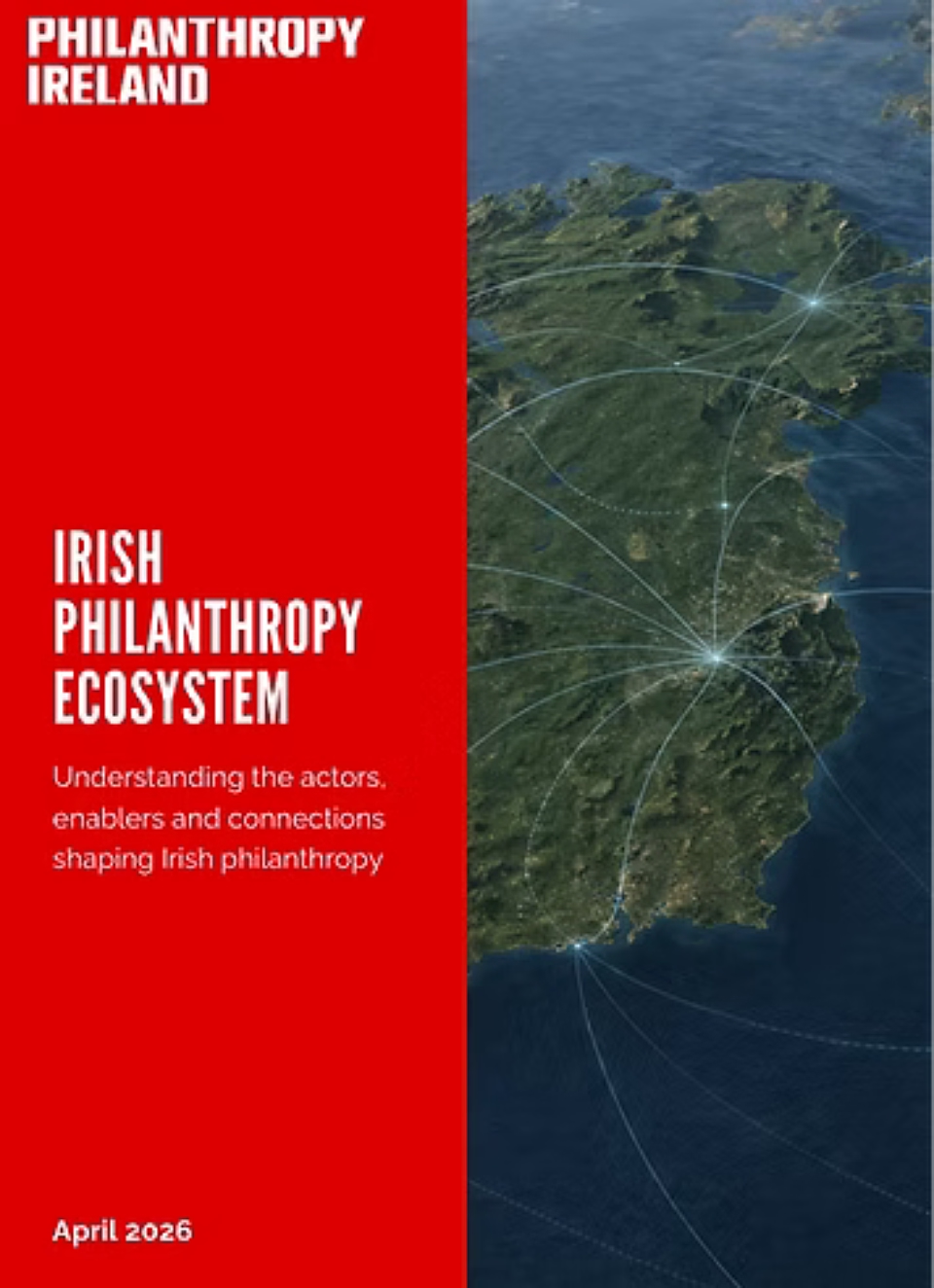
A new report from Philanthropy Ireland has mapped the structure of Ireland’s philanthropic sector,…

Posted on 13 Apr 2026
SmartyGrants is ensuring its artificial intelligence tools are fair and useful by focusing on how…

Posted on 02 Apr 2026
Grantmakers are under increasing pressure to demonstrate what their funding actually achieves –…