
How local authorities can respond to devolution’s funding shift
Posted on 07 Oct 2026
While most funding programmes run by local authorities "were designed to award grants”, the new…
Posted on 05 Oct 2026
By Matthew Schulz, journalist, Institute of Grants Management
As the UK government rolls out a sweeping devolution agenda that promises to shift power and funding control from Whitehall to England's mayors, the changes represent opportunities and challenges for the country’s grantmakers.
One of the biggest changes could see grants become the last resort in local government funding mixes.
Administrators and policy watchers are keenly awaiting a government white paper – due by the end of autumn – that will lay out legislation and detailed plans for the “Rewiring the State” declaration first announced by Cabinet in late July.
The revamp has new PM Andy Burnham’s fingerprints all over it, not least because his “rewiring” agenda – including new funding models – was stress-tested in his previous job as the mayor of Greater Manchester.
"Good growth requires a fundamental rewiring of the way our country works..."
The Cabinet’s declaration calls for root-and-branch reform of government, stating: “Good growth requires a fundamental rewiring of the way our country works, surrendering power that for too long has been held in Westminster and Whitehall, and returning it to people and the places where they live, work and invest.”
And while the project initially targets England, the UK government will examine whether the approach could be extended across Scotland, Wales and Northern Ireland.
For grantmakers, the statement could have far-reaching effects on the way they manage their funding.
Most immediately, the statement calls out likely changes to “arm's length” bodies, those semi-independent organisations formed and steered by government.
The statement said the government would "take a serious look at whether individual arm's length body responsibilities and funding should be transferred to local leaders, or returned to ministerial departments”, naming Arts Council England and Sport England funding as examples of funding that could be transferred to mayoral control.
Other affected areas include:
Preventative services: Funding for homelessness prevention, early help and community mental health support could be pooled and devolved to strategic authorities and councils.
The Social and Affordable Homes Programme: This covers capital grant funding currently run nationally through Homes England, devolved to mayors, which will be most relevant to grantmakers working with housing associations and community land trusts.
Later-stage innovation funding: Local leaders are set to win a "substantially increased share" of the funding aimed at supporting projects and companies ready to be scaled up.
Perhaps one of the biggest funding shake-ups relates to how governments are encouraged to manage funds, with every mayor encouraged to establish a "Good Growth Fund”.
These funds combine capital from national public financial institutions and the Local Government Pension Scheme for investment in local economic growth.
The model is based on the stunning economic success of Greater Manchester, a factor in former mayor Andy Burnham’s move to number 10 Downing Street. The Greater Manchester region is ranked as the third strongest region in the UK, according to a recent Oxford Economics study.
"Greater Manchester’s transformation is drawing national and international recognition."

"Greater Manchester’s transformation is drawing national and international recognition," the Greater Manchester mayor, Bev Craig, said in response to news of the ranking.
Greater Manchester's own roughly £2 billion Good Growth Fund, which has doubled in size since it was launched in late 2025, blends grants, loans and "patient equity" – that’s equity without the expectation of a quick return.
The Good Growth Fund’s contribution to the region is significant, and it accounts for a major slice of the Greater Manchester Combined Authority’s (GMCA’s) £3 billion budget.
The fund "recycles" money by using loans and equity – rather than grants – wherever possible. Those loans are repaid with interest, while equity stake can be sold or pay returns, with funds flowing back to finance the next project. Grants are treated as a last resort.
The fund pools central government funding, investments from the Greater Manchester Pension Fund, and a partnership with the National Wealth Fund.
It’s all managed by the GMCA, which seeks to "recycle funding wherever possible, and limit grants to cases where it is essential."
The GMCA applies three principles to maximise the fund’s impact:
Do just enough to lever in private sector capital
Minimise grant funding and recycle investment where possible
Capture value for reinvestment.
The fund launched in November 2025 with £1 billion in the kitty, with the aim of “recycling” money and increasing the fund to more than £10 billion over a decade. Since then, the fund has grown to £2 billion, and more than £1 billion has been allocated to loans, investments and grants.
The plan is to reinvest capital and interest from loans to then kickstart other projects.
Despite being “minimised”, grants remain a big slice of the spending. In the most recent £163 million allocation, revealed in September, £111 million in grants were allocated to transport, innovation and research, and housing.
The Manchester model is also being rolled out by other authorities. The central government’s Mayoral Revolving Growth Fund – announced at the same time as the GMCA Good Growth Fund – is a £500 million scheme with a similar structure, involving "patient, recyclable capital" to allow mayors "to accelerate investment, unlock development, and bring confidence back to markets."
Alongside Greater Manchester, other participating regions include the Liverpool city region, the North East, South Yorkshire, the West Midlands and West Yorkshire.
Local authorities have supported Burnham’s push to extend spending powers for mayors, but say more work is needed to ensure the strategy succeeds, particularly in the face of the “financial crisis” facing councils and local services.
The Local Government Association said the development was a positive step in its long-standing ambition for fiscal devolution, but councils faced a £7 billion funding gap by 2028–29.
In a recent statement accompanying an autumn budget submission, the LGA said “a financially vulnerable council sector risks undermining the value and contribution of strategic authorities”.
And it reiterated the need for the devolution agenda to include areas without mayors or strategic authorities, which currently risk missing out on the changes.
"... you cannot devolve power if the foundations are financially fragile."
The LGA’s chair, Eamonn O’Brien, said the prime minister was right to say that the national and local government power imbalance was stymieing growth.
“But you cannot devolve power if the foundations are financially fragile,” O’Brien said.
“If the government wants national, regional and local growth, it needs to fix the local foundations first. Strong, capable and financially sustainable local authorities are essential to deliver on our shared priorities for health, housing and giving people every opportunity to thrive where they live.
The LGA warned in the statement that additional funding could prevent the risk of “system-wide financial failure” as well as ensure councils could meet demand for vital services, and lead growth and reform.
The statement said any devolution program should address revenue retention, cost and demand pressures, and existing fees and charges levied by authorities; write off school grant debts; avoid transferring health budget pressures to local councils; and not lead to additional costs for authorities.
"Councils, strategic authorities and government should work together to ensure genuine devolution gives local areas the fiscal powers, tools, and capacity to shape their own futures."
“Councils, strategic authorities and government should work together to ensure genuine devolution gives local areas the fiscal powers, tools, and capacity to shape their own futures, including a sustainable financial model for local government,” O’Brien said.
“A rebalancing of power must include completing the devolution map so that every community can benefit from meaningful devolution, avoiding a long tail of areas left without the same level of devolved powers, resources or influence.”
In a related announcement the government last month announced it would review its local government reorganisation (LGR) program.
In making the decision, the Secretary of State for Housing, Communities and Local Government, Angela Rayner, said, “I want to fully test whether our proposals for local government reorganisation meet the priorities of a new administration and the new prime minister”.
The LGA was unimpressed: “There is no excuse for the government’s mishandling of this process”, a spokesperson said.
A spokesperson for the LGA also said it had compiled many resources and FAQs about the process in an information hub for councils.
Institute for Government (IfG) chief economist Thomas Pope, speaking in Manchester as part of a panel discussion on the Burnham agenda last month (September), said while devolution was not new, the government’s statement carried authority from the top.
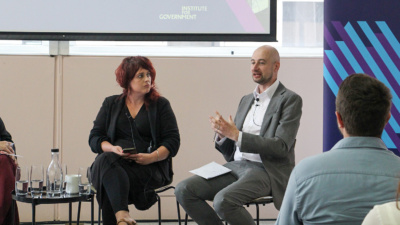
"There's now no doubt what the prime minister thinks, what indeed the Cabinet, through their Cabinet statement, thinks as well," he said.
Pope welcomed the government's commitment to redrawing public service boundaries so that authority for health, policing and local government matched up with mayoral authority areas – an alignment known by policy wonks as “co-terminosity” – in line with what Greater Manchester already does. In other areas, authority boundaries often overlap.
"Co-terminosity is massively important for making devolution work, particularly when you start to think about public services and the public service reform agenda,” Pope told the IfG panel.
“I think it's really welcome that the government seems to have got ahead of this early, and Burnham has said in the Cabinet statement that [this] is going to be a key requirement when they're thinking about reorganising boundaries, as they already are in the NHS and in policing.”
"This government is more convinced that there's a risk of keeping things the same."
Pope said the Cabinet appeared locked into a widespread rollout, whereas earlier pilots were limited in scope.
"This government is more convinced that there's a risk of keeping things the same," he said.
Fabian Society deputy general secretary Luke Raikes, on the same panel, questioned whether authorities will have the capacity to use their new powers effectively, and said there would need to be an effort to upgrade skills and knowledge in regional authorities.
"Places could have all these powers but just not have the capacity to use them yet," he said. "That is in many ways quite a simple problem to solve, because there is capacity within the civil service system itself ... it's about actually transferring capacity around the system."
Andrew Carter, CEO of the Centre for Cities think tank, suggested there were teething issues in the devolution agenda, saying in a blog post last month that while the Rewiring the State agenda was “the right diagnosis”, “Whitehall has integrated funding more quickly than it has relinquished control over how it is used”.
Central departments, he said, “remain heavily involved in determining how mayoral authorities should spend the money”, especially through control of outcomes frameworks, and the hope was that Whitehall would release some of those outcome controls in areas such as transport, employment and housing.
“This is what makes Rewiring the State potentially significant. Alongside commitments to reduce targets and increase flexibility, the government proposes allowing mayoral strategic authorities to retain a share of locally generated income tax revenues. This could better align local incentives with national economic objectives. If a stronger local economy increases the resources available to the mayor, there is a clearer fiscal reward for pursuing growth. But incentives only work when decision makers control the policy levers needed to respond to them.”
"If a stronger local economy increases the resources available to the mayor, there is a clearer fiscal reward for pursuing growth."
Centre for Cities has outlined how fiscal devolution could increase revenue to mayoral authorities, recommending that the Integrated Settlement method should be replaced by tax sharing to increase available funds by billions. Currently, nearly two-thirds of their funding comes from grants via the central government.
The government's spending watchdog, the National Audit Office (NAO), assessed the existing devolution framework in a detailed audit released about a month before Rewiring the State was announced. That audit found the existing system was wanting.
The NAO’s study revealed the hurdles the new agenda must overcome, and which the later Cabinet statement promises to address.
The NAO found seven mayoral authorities had already been handed an Integrated Settlement, a single funding pot pulled together from multiple government departments, worth £15.9 billion between 2025–26 and 2029–30. Greater Manchester holds the largest share, at £3.5 billion.
But the report found significant issues with those funding arrangements. For example, each authority must negotiate an individual outcomes framework with every department that contributes money, and auditors found these negotiations were lengthy, department-led, and shaped more by what Whitehall wants to prove to Parliament than by local priorities.
For example, the Department for Transport initially demanded 44 separate performance indicators from mayors before negotiating that down to 21. The Department for Work and Pensions simply mandated a string of outcomes, while one authority described the arrangement as less like devolution and more like "delegated budgets."
The Rewiring the State announcement by the Cabinet has promised that outcomes frameworks for mayoral authorities would be “streamlined”.
Auditors warned – in a view echoing Raikes’ analysis – that authorities may lack the institutional experience that let Greater Manchester manage its settlement effectively, and repeated a warning first made in a 2017 report on combined authorities: the "real test" of devolution is whether it works without a decade of favourable groundwork behind it.
The NAO report also suggested that in the case of financial underperformance, the central government would be able to increase monitoring, reintroduce spending controls, ring-fence money, or even suspend an authority's Integrated Settlement and reclaim funding.
Auditors concluded that while the changes had been significant, reporting burdens were heavier than intended and the approach for tackling underperformance was untested.
While the intentions of the Downing Street are clear, it appears government departments will still need to relinquish more controls for devolution to succeed.
Grants Management Intelligence contacted the Government Grants Management Function office, which sits within Cabinet, promotes best practice, and supports departments with their grant schemes through a central administrative service.
The office did not respond to GMI’s questions on how its role might change through devolution; changes to standards and processes; relationships with other bodies; and further consultation and timelines. It instead issued this generic statement: "The Government Grants Management Function supports local authorities by sharing central government best practice guidance, that local leaders can draw upon to deliver good growth in every postcode."
Posted on 07 Oct 2026
While most funding programmes run by local authorities "were designed to award grants”, the new…

Posted on 05 Oct 2026
At its simplest, place-based work brings people, organisations and resources together to address…

Posted on 26 Aug 2026
A small UK grantmaker believes new technology should not undermine the value it places on the human…

Posted on 25 Aug 2026
A decade of independent audit evidence reveals there’s a big gap between good grants policy and…

Posted on 24 Jun 2026
A just-published report tracking philanthropic and voluntary sector grantmaking in the UK shows…

Posted on 24 Jun 2026
The International Fund for Ireland, Stratford Town Trust and Glasgow City Council are among the…

Posted on 04 Jun 2026
SmartyGrants speakers highlighted opportunities to introduce consistency in areas such as…

Posted on 27 May 2026
I've spent a fair chunk of my career listening to what I've come to call "grants rage." On one…
Posted on 27 May 2026
A new report from Philanthropy Ireland has mapped the structure of Ireland’s philanthropic sector,…

Posted on 13 Apr 2026
SmartyGrants is ensuring its artificial intelligence tools are fair and useful by focusing on how…

Posted on 02 Apr 2026
Grantmakers are under increasing pressure to demonstrate what their funding actually achieves –…